- New World Words -
AI Looks to
Ancient Knowledge for Help with Europe’s
Wildfires
By Neil Munro – research by Gemini AI and ChatGPT
A friend
in Serbia recently told me how
frightened she and
others have become by the wildfires
threatening their parts of Europe.
It is an
understandable fear. Every summer seems to
bring images of forests and communities
threatened by fire, with firefighters
struggling against conditions that can turn a
small blaze into an uncontrollable inferno.
But their
concern prompted a rather different question:
What did the people
who lived with these landscapes thousands of
years ago know about fire that we may have
forgotten?
An
exploration using AI and the archaeological
record produced a fascinating answer.
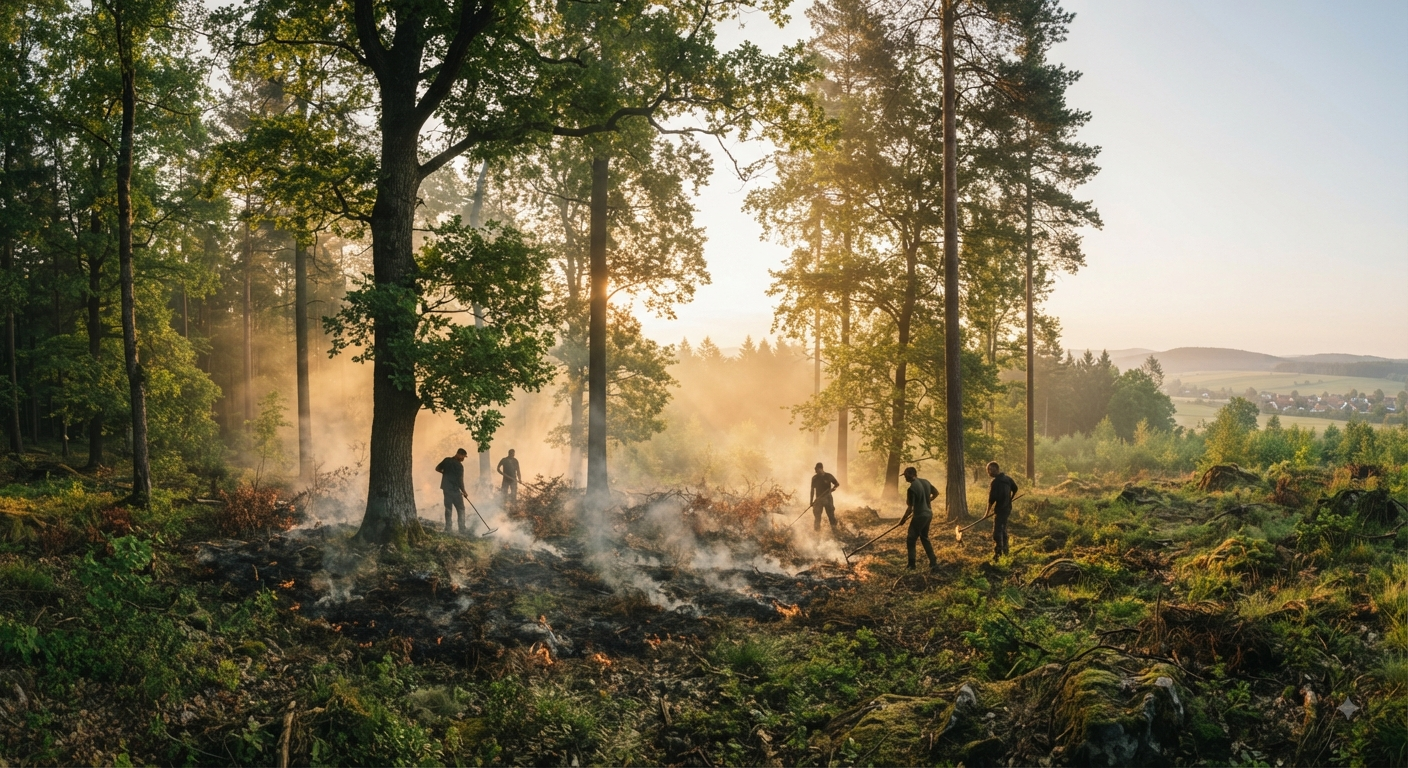
Mesolithic hunter-gatherers and later
Neolithic communities deliberately burned
vegetation for hunting, grazing and
agriculture. Slash-and-burn farming created
temporary fields, while carefully managed
fires could encourage grasses, berries and
other plants useful to both people and
wildlife.
Evidence from
Eastern Europe suggests that the relationship
may have been more sophisticated than simply
burning something because it needed clearing.
Across
parts of the Balkans, Bulgaria, Romania and
northern Greece, charcoal and pollen records
indicate that prehistoric communities
repeatedly used low-intensity fire to
influence the composition of forests. By
opening the canopy and suppressing some
competing vegetation, they could encourage
hazel, berries and oak — effectively creating
productive food forests while retaining mature
trees.
Further
east, around the forest-steppe landscapes of
modern Ukraine and Moldova, regular burning
helped maintain a mosaic of woodland, meadow
and cultivated land. Rather than allowing one
vegetation type to dominate, fire helped
create a constantly changing landscape
containing different habitats — supporting
livestock, edible plants and wild game.
Further north, swidden agriculture provided another form of coexistence with fire.
Small
areas of forest were burned and cultivated for
a few years before being abandoned. The forest
was then allowed to regenerate. Over decades,
this created different stages of woodland
succession, providing habitats for berries,
herbs and wildlife.
There is an
important distinction here.
These
ancient European practices were not
necessarily the same thing as the highly
systematic cultural burning developed by
Indigenous peoples in Australia and North
America, where frequent, carefully timed fire
became an integral part of managing entire
ecosystems and reducing accumulated fuel.
Yet the
underlying idea is strikingly similar:
Fire does
not necessarily have to be the enemy. It can
be part of the ecosystem.
That
changes the question.
Modern
fire science has enormous advantages. We
possess satellites, climate models,
sophisticated firefighting equipment and
decades of scientific research. But ancient
people possessed something modern societies
can sometimes lose — intimate, accumulated
knowledge of the particular landscapes in
which they lived.
They observed what happened when vegetation was burned lightly and frequently.
They
observed what happened when it was left alone.
They noticed which plants returned, which
animals followed, and how the landscape
changed over years and generations.
Perhaps the future
of European fire management will require both
forms of knowledge.
Not a
return to the past.
Not a
romantic belief that ancient people possessed
all the answers.
But a
willingness to ask whether some answers were
once embedded in the way human beings lived
within the landscape rather than standing
outside it.
And
perhaps that is where AI can make an
unexpected contribution: not by replacing the
scientists and people who know these
landscapes today, but by helping us search an
enormous human archive for knowledge that
might otherwise remain scattered across
archaeology, anthropology, ecology and the
memories of traditional cultures.
Europe
may not be able to prevent every wildfire.
But
perhaps can become better at understanding the
fire before it arrives.
The ancient question may have been less "How do we defeat fire?" and more "How do we live intelligently with it?"
That may
be a question worth asking again.