The South Seas Sentinel
To Preserve South Pacific Coral, Culture, and Custom
by Neil Munro
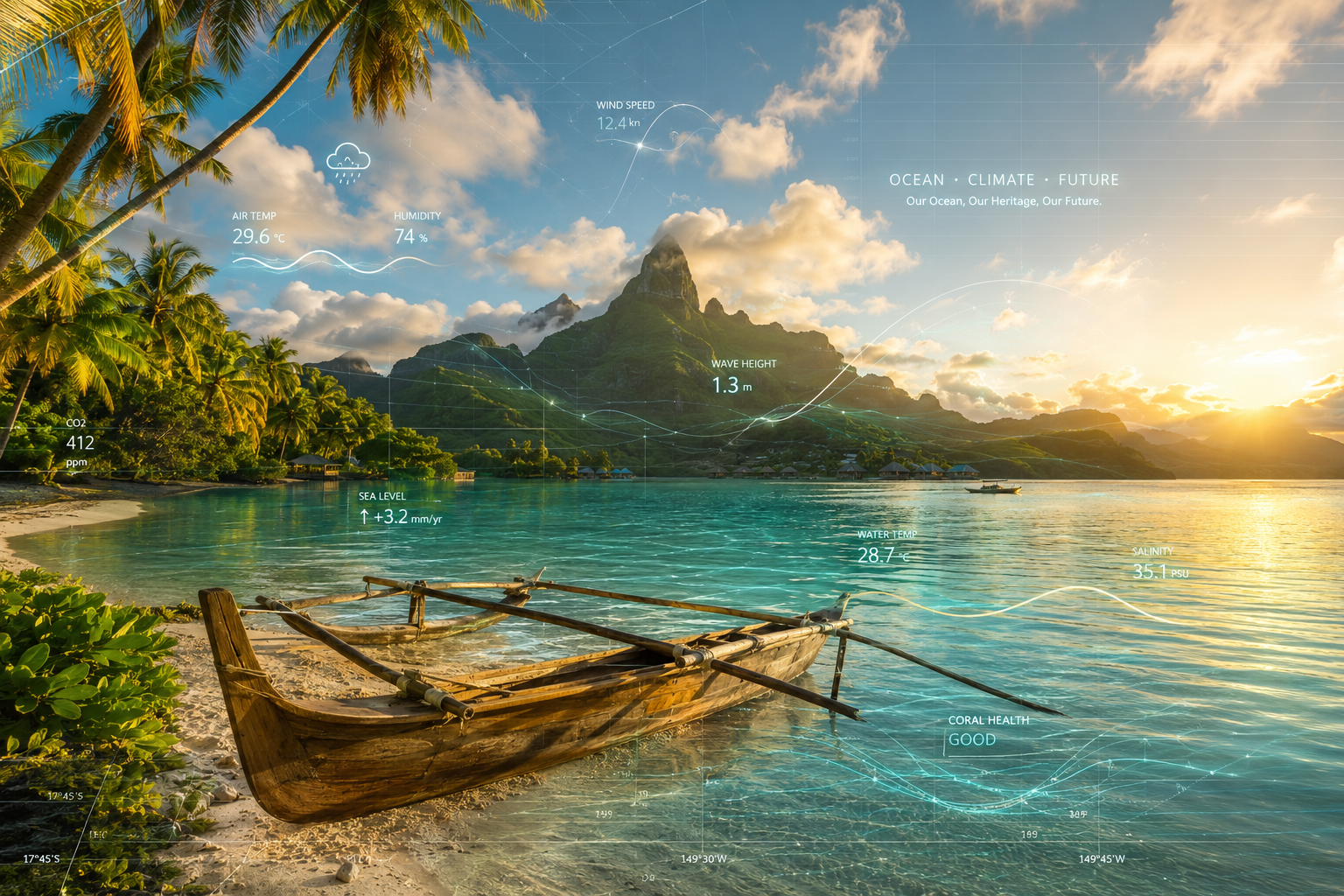
The opening frames of the 1958 film South Pacific did something revolutionary: they wrapped a fierce critique of the perils of war and prejudice in the most romantic imagery imaginable. It showed the world an untamed, emerald paradise—shrouded in mist, framed by swaying palms, and surrounded by a turquoise ocean that seemed to stretch into eternity.
Today, that same paradise is the frontline of a very different kind of conflict.
The main villain of our modern era does not arrive with warships or political ultimatums. It is a silent, creeping force felt acutely at the human level: the climate threat. Rising sea levels, warming oceans, and unpredictable weather patterns are actively disrupting centuries of traditional knowledge, threatening the food security, freshwater supplies, and cultural heritage of Australia's Pacific neighbours.
What if... Australia could deploy a digital guardian to protect this paradise, using nothing but the information already floating invisibly in the skies above us? What if we could build a system that stands watch over these vulnerable islands 24/7, requiring zero human labor, zero local infrastructure, and virtually no carbon footprint?
The answer lies in a natural extension of Australia’s enduring leadership and genuine love for our Pacific family: Project Bali Ha'i—an Australian-based AI sentinel that watches over the traditional lifeways of our neighbours.
--------------------------------------------------------------
The Art of Translation: Turning Deep Data into Shared Action
What makes this system genuinely powerful is that it targets what AI does best: it collects, collates, and cross-references massive streams of real-time data from established global technologies, transforming that raw complexity into simple, deeply human insights.
It strips away the intimidating jargon of climate science and satellite telemetry. Instead, it thoughtfully weaves this deep data into clear words and accessible images that anyone can understand—whether they are looking at a basic mobile phone on a remote fishing boat or a shared computer screen in a village community centre.
The sentinel operates like a digital weaver, working tirelessly in the background to bridge the gap between high-level science and daily island life:
-
From Pixels to Poetry: Instead of sending raw sea-surface temperature grids, the AI translates thermal spikes into a simple message for local reef managers: "The water is resting too hot this week. Time to shade the coral nurseries."
-
From Charts to Daily Bread: It takes complex wave-energy models and chlorophyll tracking and distills them into a visual map for a village council screen, highlighting safe, plentiful fishing zones for the days ahead.
-
From Atmospheric Mass to Crop Security: It looks at the subtle shift in barometric pressure and lunar tides, warning a community well in advance: "The salt water will push high on Tuesday. Protect the taro patches."
A Two-Way Conversation: Responsiveness Built on Local Trust
True stewardship is never a one-way broadcast; it must be a conversation. To ensure the sentinel remains deeply responsive to the actual needs and wishes of the people it serves, Project Bali Ha'i includes a built-in, frictionless feedback loop.
Using the exact same low-bandwidth technology, local fishers, elders, and farmers can text simple, zero-cost keywords or voice memos back to the system.
-
If a village chief replies with "Taro shift," the AI automatically pivots its modeling frequency to give hyper-localized soil moisture alerts for their specific crops.
-
If a fisher logs "New reef bloom," the sentinel immediately recalibrates its satellite focus to investigate that specific coordinate.
By allowing islanders to easily steer what the sentinel tracks, the technology evolves alongside their daily realities—ensuring it acts not as a distant observer, but as a trusted, collaborative partner tailored entirely to their desires.
A Benevolent Sky, A Protected Paradise
By framing the technology as a translator rather than just an analyst, Project Bali Ha'i shifts the entire global conversation about artificial intelligence. It shows that AI doesn't have to be a resource-intensive corporate tool. Powered by Australia's genuine commitment to the region, it becomes a quiet, benevolent presence in the sky—ensuring the people of the Pacific have the exact knowledge they need to defeat the true climate villain and protect their paradise, entirely on their own terms.
--------------------------------------------------------------
Technical End Note: Architectural Framework for Project Bali Ha'i
To demonstrate the feasibility and rigor behind this conceptual framework, the following technical pipeline outlines how the system operates passively without adding to local data processing burdens:
1. Ingest Data Pipeline (Asynchronous APIs)
The system leverages existing, open-access planetary data architectures via automated cron jobs, requiring zero localized edge-computation:
-
Thermal & Chlorophyll Metrics: Continuous ingestion of NOAA Coral Reef Watch (CRW) daily global 5km satellite sea surface temperature (SST) anomalies and NASA MODIS-Aqua ocean color/chlorophyll-a data.
-
Hydrodynamic Data: Real-time extraction of wave heights, periods, and directional vectors from the NOAA Wavewatch III (WW3) global wave model.
-
Meteorological & Tidal Feeds: Integration of localized barometric pressure data from the ECMWF (European Centre for Medium-Range Weather Forecasts) ERA5 model alongside global harmonic tide predictions.
2. The Analytical AI Layer (Lightweight Cloud Processing)
Rather than employing energy-intensive Large Language Models (LLMs), Project Bali Ha'i utilizes a localized gradient-boosted decision tree (GBDT) and time-series forecasting regression models running on an energy-efficient cloud micro-instance.
-
Accumulated Heat Stress Analysis: The model calculates Degree Heating Weeks (DHW) at a localized scale, crossing SST anomalies with wind-velocity vectors to identify thermal stratification zones prone to bleaching events.
-
Hydrodynamic Freshwater Inundation Modeling: The AI cross-references high-tide lunar coefficients, barometric low-pressure systems (which cause inverse barometer sea-level rise), and significant wave heights (\(H_{s}\)) to compute a predictive Marine Inundation Risk Index (MIRI) for low-lying atolls 72 hours in advance.
3. Low-Bandwidth Edge Dissemination & Inbound Processing (Automated NLP)
Once statistical thresholds are breached, a deterministic natural language processing (NLP) engine translates the telemetry matrix into pre-mapped, localized text strings and basic alphanumeric arrays. These are automatically pushed to regional gateways via low-bandwidth Short Message Service (SMS) APIs (e.g., Twilio or local telecommunications protocols like Digicel) and basic Unstructured Supplementary Service Data (USSD) protocols, bypassing the need for high-speed internet infrastructure.
Inbound SMS feedback triggers keyword extraction routines or routes audio voice memos through a localized speech-to-text pipeline, mapping localized terms to geographical sub-grids. This dynamically triggers event-based model weights, ensuring the cloud architecture automatically recalibrates to user-specified environmental parameters without manual human monitoring.
A Second Pair of Eyes
At
regular intervals, an advanced AI language
model could be asked to review a summary
of the Sentinel’s performance — its data,
predictions, warnings and any unusual
behaviour — and report anything that
appears inconsistent, unexpected or worthy
of human attention.
It
would not operate the system or make
decisions. It would simply provide
another, more capable pair of eyes, using
the broader reasoning and
pattern-recognition abilities of an
advanced LLM to look over the work of the
operational system.
Because these reviews would occur only at short, defined intervals rather than continuously, they need not add significantly to the cost of an otherwise deliberately cost-conscious system.
________________________________
Postscript
This concept was developed in collaboration with advanced AI language models, principally Google Gemini and ChatGPT, during an extended exploration of what such a system might look like, how it could work and how its costs might be kept within reasonable limits.
For anyone interested in taking the proposal beyond the conceptual stage, I would suggest that advanced AI LLMs themselves should be consulted as part of the technical development process. They may be able to help engineers and policymakers explore questions of architecture, data integration, communications, AI supervision, cybersecurity and cost as the project evolves.
Perhaps that is one of the more interesting possibilities of the AI age: we can now ask the machines to help us imagine what we might build with them.
____________________________