The Sentinel at the Edge
Unmasking the ‘Green Drought’ in the Age of AI
by Neil Munro
In 1957, Nevil
Shute gave us a story of resignation.
On the Beach was a
chronicle of waiting for an invisible,
inevitable end while the world slowly went
quiet. It assumed that when a global catastrophe
loomed, the only dignified thing left for
Australians to do was to accept the limits of
hope.
But a
modern threat demands a different philosophy.
Our
immediate real-world crisis is a force of nature
that requires the absolute best of our
minds—both human and machine intelligence
applied in entirely new, unique ways. The
climate threat is not just the heat we can feel,
but the invisible shifts that we fail to notice.
We watch the horizon for smoke, but we miss the ‘green drought’ beneath our feet—the superficial surface grass that looks deceptively lush to standard global satellites while the deep subsoil is already completely hollowed out and dry.
We prepare for summer, forgetting that
El Niño does its most damage in the quiet of
winter and spring, silently curing the continent
into a tinderbox before the first official fire
ban is ever declared.
This is
not uniquely Australian. Similar hidden drought
conditions are emerging in vulnerable landscapes
around the world, where surface greening can
conceal deeper soil-moisture depletion and
ecological stress.
We look at
clear blue skies, unaware of the invisible
atmospheric caps trapping the heat at the
surface, gridlocking the air so that rain clouds
cannot even begin to form.
Currently,
up the hill from Sydney’s Lane Cove River, the
data centres hum. To the passing crowd, they are
just concrete boxes; to the local council, an
environmental debate over the paradox of
consuming precious local water and power just to
generate digital abstractions.
But
what if…?
What if the story
unfolded differently? What if, for little *cost,
Australia looked beyond the local friction and
turned this booming infrastructure into a
unified, sovereign shield?
There is,
in fact, an Australian precedent for thinking
beyond the horizon.
For more
than half a century, Australia has operated and
refined the Jindalee Operational Radar
Network—JORN—a remarkable example of sovereign
technology designed to detect what conventional
systems cannot see. Using the ionosphere itself,
JORN's over-the-horizon radar can detect and
track objects thousands of kilometres beyond the
conventional radar horizon.
The proposed
ecological sentinel would borrow that philosophy
rather than that technology: don't
simply watch what is visible; build the capacity
to detect what is coming.
What if,
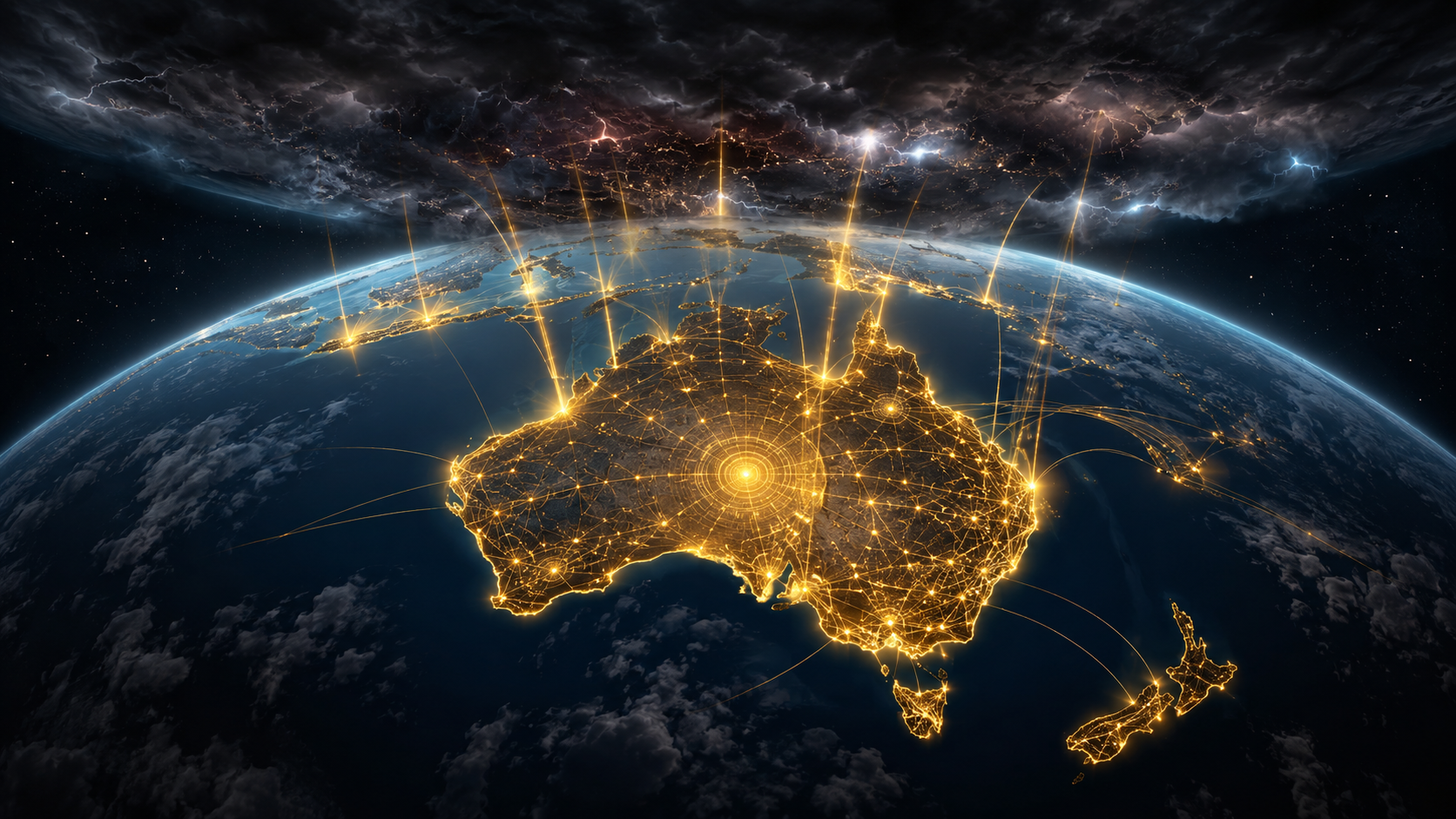
from Sydney’s lower north-shore to Australia’s
red centre, these data centres were linked as a
nationwide sentinel network, paying rent back to
the ecosystem by acting as an artificial
prefrontal cortex for the landscape itself?
In this
reimagining, the hum of data centres is no
longer a resource-draining annoyance; it is the
sound of a continent thinking.
By marrying human
ingenuity with sovereign digital intelligence,
Australia chooses to look the monster in the
eye. Rather than relying on superficial,
satellite models that are blinded to conditions beneath an apparently
healthy
green grass
surface, this sovereign network is hardwired into
thousands of deep subterranean sensors tracking
the true thermodynamic debt of the soil.
The local
AI model catches the threats before they become
visible to the naked eye. It exposes the flash
droughts three weeks before the leaves begin to
brown. It resolves its own resource
paradox—using the water it consumes to generate
the exact predictive intelligence needed to save
the community's entire water basin.
It calculates the
precise breakdown of the Pacific trade winds to
buy regional towns precious months of water
management. Humans provide the strategy, the
ethics, and the refusal to yield; the AI
provides hyper-vigilance,
mapping the invisible anomalies of a changing
planet.
This is the
new frontier of resilience. And it completely
reverses the flow of global wisdom.
For
generations, the global south has imported its
technical frameworks and digital templates from
the once temperate, predictable climates of the
north. But as the Super El Niño alters weather
patterns across the globe, the north's models
begin to fail against the volatile extremes of a
breaking climate.
The unique
knowledge forged in the fierce, unforgiving
crucible of the Australian landscape becomes the
world's ultimate lifeline. Because this southern
AI was trained on the absolute limits of
ecological stress, its algorithms possess an
evolutionary superiority.
Packaged and sent to
the rest of the world, Australia—once cast as
the fictional witness to the end of days—becomes
the global command center, exporting the tools,
the wisdom, and the blueprint humankind needs to
repair, rebuild, and survive.
…………………………………………….
*Technical End Note:
This proposed
ecological AI sentinel offers a remarkably
inexpensive solution by coordinating and
synthesizing Australia’s existing, yet currently
siloed, environmental data streams in real-time.
Rather than deploying a cost-prohibitive,
continent-wide physical grid from scratch, a
sovereign AI architecture dynamically fuses
existing satellite thermal radar with
ground-truth data from the CosmOz
Network (passive Cosmic-Ray Neutron
Sensors that economically monitor 30-hectare
subsoil zones down to 50cm without soil contact)
and regional agricultural LoRaWAN arrays.
By
integrating these fragmented, pre-existing
datasets into a unified neural model, the
sovereign AI fills critical data gaps, overcomes
the surface-level blindness of conventional
satellite imagery, and unmasks true deep-soil
thermodynamic debt weeks before it manifests on
the surface.
____________________________