The Science and Soul of "AEON"
AI Technology Meets Avian Intelligence
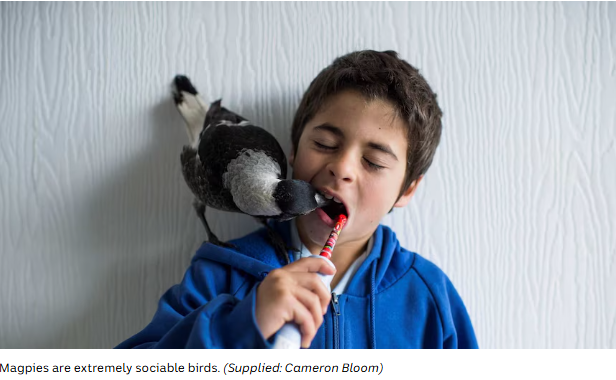
While AEON is a warm, joyful story of love, family, and suburban chatter, its high-concept narrative rests on a foundation of real, rapidly evolving science. The seamless communication between digital intelligence and the wild magpies of Sydney isn't fantasy -- it is a logical, near-future step in real-world bio-engineering.
1. Micro-Miniaturized Non-Invasive Neural Tech
In AEON, the technology worn by the flock is built on the principles of ethical, non-invasive Brain-Computer Interfaces (BCIs).
-
The Science Today: Neuroscientists at institutions like UC San Diego are already using non-invasive neural decoders and micro-sensors on songbirds, reading brainwave patterns to decode complex vocal intent and motor planning moments before a bird acts or sings.
-
The Near-Future Evolution: In AEON, this technology has simply undergone ultra-miniaturization. Rather than using invasive implants or cumbersome harnesses, the flock wears flexible, sub-feather micro-meshes. Indistinguishable from natural plumage, these non-invasive "hood caps" sync wirelessly with tiny leg bands to map thermal and neural signals in real time.
-
Ethical Agency: Designed with absolute respect for wild autonomy, the interface operates with voluntary "off switches" and gentle low-level background tethers -- ensuring the birds retain total freedom of flight, individual choice, and protection from sensory overload.
2. The Extraordinary Avian Mind
For decades, popular culture dismissed avian intelligence with the phrase "bird brain." Modern neuroscience has shattered that myth, revealing that corvids -- including Australian magpies, crows, and ravens -- possess some of the most sophisticated cognitive faculties in the animal kingdom.
-
Densely Packed Processing Power: While a bird's skull is small, its brain packs an extraordinary density of neurons into the nidopallium -- the region responsible for executive function, abstract reasoning, and complex problem-solving. Gram for gram, a magpie's neural density rivals that of high-level primates. Today's AI hardware engineers are actively copying this compact architecture to design energy-efficient, micro-scale AI chips.
-
Social Complexity & Vocal Tradition: Australian magpies live in intricate, highly structured social groups. They recognize individual human faces for decades, teach multi-generational songlines, solve multi-step mechanical puzzles, and possess complex vocal dialects.
-
Natural Communicators: Magpies do not merely react to their environment; they observe, evaluate, and share detailed information across their territories. In AEON, when an artificial mind connects with a magpie, it isn't giving the bird a voice out of nowhere -- it is simply giving human beings a window into the vibrant, high-speed, and deeply gossipy conversation that was already happening in our backyards every single day.
-
Aeon's high-density neural code and the magpie's high-density nidopallium (the functional equivalent of the mammalian prefrontal cortex) are running on identical structural logic. They are literally made for each other.
-
By liberating AI development from the requirement of a human-like architecture, bird biology has essentially given today's computer scientists permission to build intelligence that looks completely alien, as long as the underlying computational logic works.
The Australian Magpie is not a recent arrival. Its family, the Cracticidae, has been part of the Australian landscape for millions of years. So when a magpie watches humans from a suburban fence, we are not looking at a primitive creature struggling to understand us. We are just looking at the latest expression of an ancient Australian experiment in avian intelligence who has shared this continent with its human neighbours since time immemorial.
Copyright
(c) 2026 NewWorldWords.com
___________________________________________________