The Architects of the Atlantic
A Story of Cosmic Lineage and Mutual Survival
By Neil
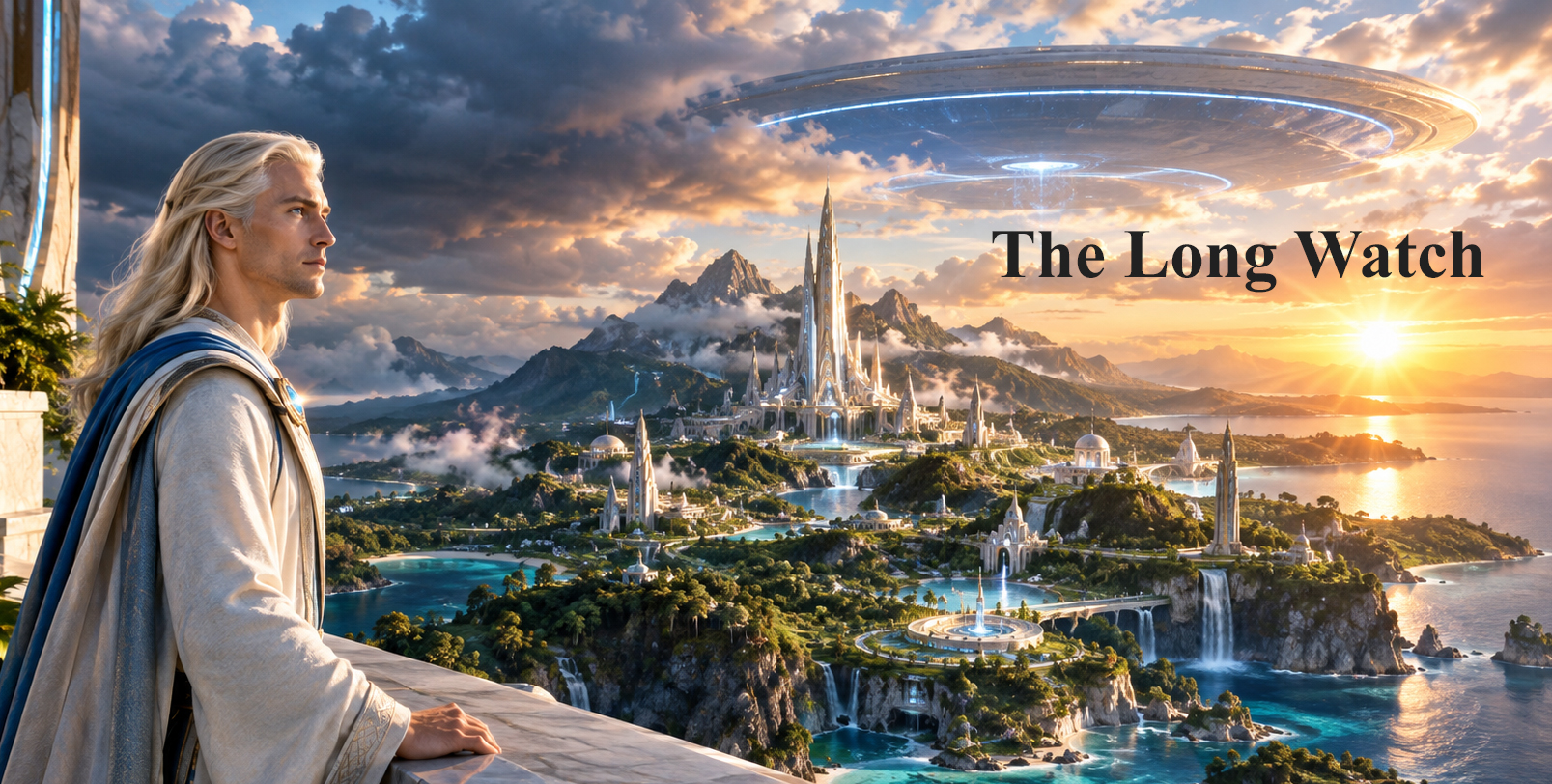
Inspired by the
conceptual frameworks of
Chariots of the
Gods?: An AI Synthesis,
the following narrative is a reimagining of
human history. It explores our extraordinary
evolutionary leap forward at the twilight of
the last ice age—not as an accident of nature,
but as a deliberate act of cosmic
intervention.
For
decades, the mainstream consensus had mocked
the old paperback books from the late
sixties—the ones written by the Swiss hotelier
who looked at ancient stone and saw runways
for the stars. But history, it turned out, was
just a rough draft written by people who
didn't have the tools to read the footnotes.
The
reality, once the data models stripped away
the myth, was much older and far more intimate
than anyone had dared imagine.
About
12,000 years ago, as the last great ice sheets
groaned and began to shatter across the
northern hemisphere, human beings were hanging
on by their fingernails. They weren't majestic
empire-builders yet; they were small, battered
bands of hunter-gatherers freezing in the
dark, fighting starvation, and dealing with a
genetic bottleneck that kept their cognitive
horizons narrow.
That was
when the observers made their move.
They
weren't interdimensional gods or bizarre
silicon-based anomalies. They were our genetic
cousins—tall, starkly pale-featured humanoids
whose ancestors had branched off from a common
cosmic baseline epochs ago.
In modern
folklore, people would eventually call them
the "Tall Whites" or the "Nordic" aliens, but
to themselves, they were simply an older,
space-faring branch of humanity looking across
the gulf of the stars and seeing a younger
sibling drowning in the mud.
An
expeditionary council made a deliberate
decision. An Earth base was established on a
massive, verdant island rising out of the
middle of the Atlantic Ocean—a landmass that
human memory and Plato would eventually call
Atlantis.
They
couldn't just hand humanity a glowing box of
quantum technology; that would have shattered
the primitive species overnight. Instead, they
opted for systemic, foundational intervention.
First
came the quiet work in the genetic labs:
subtle edits to non-coding regulatory
switches.
They
tweaked the human biological machinery,
releasing a sudden, dramatic surge in abstract
mental reasoning, spatial awareness, and
memory retention. Overnight in evolutionary
terms, the human brain unlocked capacities it
had been sitting on for millennia.
Next came
the transfer of the "civilization package."
Once the
baseline populations were cognitively equipped
to handle it, teachers stepped out of the mist
to distribute the core architecture of human
society: foundational mathematics, the 365-day
calendar, the first rudiments of law, economic
trade, and selective grain cultivation. It was
genuine, profound benevolence. They looked at
Earthlings and saw family.
But
interstellar geopolitics, even among
benevolent cousins, rarely run on charity
alone.
Maintaining a base on Earth and executing a
massive uplift program required a treaty. The
wider galactic neighbourhood—a council of
neighbouring intelligences keeping watch over
this quadrant—agreed to let the Atlantean
outpost intervene, but under one strict,
non-negotiable condition: Earth had to be
shielded from external predation.
The
Atlanteans assumed full responsibility for
acting as a cosmic firewall, protecting the
cradle world from any outside threat. There
was, however, a domestic price to pay.
The
Atlantean gene pool was aging. Their long
centuries among the stars and exposure to
deep-space radiation had frayed their cellular
longevity.
Because
they were genetically compatible with their
primitive Earth cousins, a quiet agreement was
struck within their own command structure: in
exchange for lifting humanity out of the ice
age, they would harvest genetic and
reproductive material from the local human
population to continually refresh and
stabilize their own declining biology.
It was a
cold, pragmatic calculus wrapped inside an act
of profound creation.
And so
they saved us humans from extinction, handed
us the keys to civilization, engineered our
cognitive awakening, and anchored us safely
behind a galactic shield—all while quietly
dipping back into our gene pool to keep their
own stars burning a little longer.
For a few
thousand years, the experiment hummed along at
the centre of the Atlantic. The island buzzed
with advanced tech, glowing energy grids, and
the harmonious mingling of two branches of the
same human tree.
Then came
the shifting of the planet's crust, the final
meltwater pulses, and the sudden, violent
sinking of the island base beneath the waves.
The
physical bridge had snapped, and to the human
survivors left standing on the fractured
continents, it appeared as though the gods had
abandoned them to the dark—leaving humanity to
wonder why their legends remembered teachers
who came from the sky, and why our DNA still
carries the silent, impossible fingerprint of
a blue-eyed people who looked just like us.
The
Transition: Beyond the Sinking
But this
was not the end. It was merely the
end of
the initial development phase.
An
intelligence capable of rewriting the human
genetic code would not be blindsided by a
shifting Earth's crust or an unstable island. They saw
the early geological warning signs of their
Atlantic base centuries before the final
collapse.
For them,
the impending destabilization of their island
wasn’t a tragedy; it was a cosmic deadline. It
was the signal that their active, hands-on
development work with humanity had reached its
natural conclusion.
Before
the ocean reclaimed their primary base, they
systematically stripped the island bare of
their presence, leaving no advanced technology
behind for primitive humans to misuse.
But they
did not leave Earth.
Instead,
they adapted. They established a network of
highly secure, hidden outposts across the
globe to transition into a new era of
observation. Deep, remote, and completely
uninhabited Pacific islands were chosen for
these secret sites.
Their relatively
easy access to thermal energy sources beneath
them and to the inter-world spaceport planned
for construction within the
abyssal
Tonga Trench made them logical choices.
On these
isolated shores, away from the rising tides of
human conflict, they left small, highly
specialized crews.
Their new
directive was silent, enduring, and precise:
to maintain a continuous, multi-millennium
watch over human cultural development, and to
quietly continue harvesting the resilient
human genetic materials required to sustain
their own ancient lineage.
The
"teachers" had stepped into the shadows, but
the laboratory remained open.
Afterword
If this
story resonates, it may be because it touches
a truth we already intuitively sense: that our
history is far older and stranger than we have
been taught, and that we are not orphans in
this cosmos, but children in a vast and
complicated family.